

October 26, 2009
Armstrong Medical Education Building dedicated
State-of-the-art facility will be home of revolutionary new curriculum
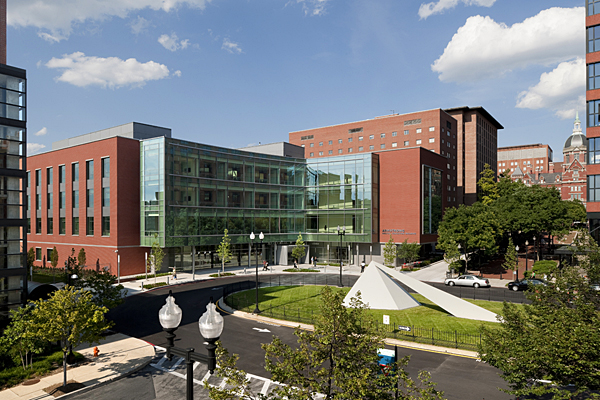
The Anne and Mike Armstrong Medical Education Building, dedicated on Saturday, provides a state-of-the-art home for the School of Medicine’s new curriculum.
More than a century ago, Johns Hopkins revolutionized the teaching of medicine with a new curriculum that merged evidence-based science with patient-centered clinical care. This so-called Hopkins model became the national gold standard for modern medical education.
Now, Johns Hopkins is launching the second revolution in medical education, and it will take place within a new, state-of-the-art education building designed to support the new Genes to Society curriculum. The curriculum is notable for its systems approach to understanding all levels of the human being, from the genes, molecules, cells and organs of the patient to the familial, community, societal and environmental components that affect patient health.
The formal dedication ceremony for the Anne and Mike Armstrong Medical Education Building, located adjacent to the Johns Hopkins Outpatient Center on the East Baltimore campus, took place on Saturday afternoon.
Speaking in an interview before the dedication, Edward D. Miller, dean of the medical faculty and CEO of Johns Hopkins Medicine, said, “We will do more than formally announce the opening of a wonderful new building. We will usher in a new era of medical education that raises the bar even higher and that will be as transformative for this century as the original Hopkins model was for the last.”
“Our Genes to Society curriculum builds on the fundamental insights learned during the past several decades through the study of molecular biology,” said David G. Nichols, vice dean for education and professor of anesthesiology and critical care medicine. “With this new knowledge, and within this beautiful new building, students will begin by studying the basic building blocks of life and progress through higher and higher levels of organization and complexity. Through the use of advanced teaching technologies and collaborative learning, Genes to Society marks a revolution in medical education.”
This milestone curriculum will be taught within a building designed to accommodate, nurture and encourage learning opportunities. The building’s advanced anatomy lab, digital classrooms and laboratories, lecture halls and study areas are designed to better prepare physicians for fully understanding the relevance of science to patient care.
The 100,000-square-foot building is named in honor of Anne and Mike Armstrong, whose generous donation helped fund its construction. Mike Armstrong is the chair of the boards of Johns Hopkins Medicine, The Johns Hopkins Health System Corp. and The Johns Hopkins Hospital.
“Johns Hopkins is an institution whose culture is rich with tradition and innovation,” he said. “It is here that the practice of modern medicine was born, and it is here that we will begin a new chapter in Hopkins’ storied history. It is my and Anne’s great honor to have had a part in creating this fabulous new building. We know that it will graduate new generations of physicians and researchers who will extend the frontiers of medicine.”
The four-story building contains a lecture hall and cafe on its first floor; the college advisory program, a learning studio and classrooms on the second; teaching labs and academic computing facilities on the third; and anatomy labs and reading rooms on the fourth.
For more about the Anne and Mike Armstrong Medical Education Building and the Genes to Society curriculum, or to view additional photographs of the building, go to www .hopkinsmedicine.org/armstrongbuilding.